How Much Protein Do Women Over 40 Need?
There's no one perfect protein number after 40 — but there is a clear, practical way to think about it. Here's what shapes your needs and what the guidance really says.
The honest answer: it depends on you. There is no single protein number that fits every woman over 40. Your needs are shaped by your body size, age, activity, goals, health and any medical circumstances. What published guidance does offer is a sensible starting frame — and for most women, the practical takeaway is simpler than any number: include a real protein source at each meal and notice how you feel.
This article focuses on the question of how much. For the bigger picture on building protein-first keto meals, start with the main guide:
What Shapes Your Protein Needs
Two women of the same age can have quite different needs. The main factors include:
- Body size — larger bodies generally need more protein than smaller ones
- Age — guidance for older adults tends to be somewhat higher than for younger adults
- Activity — regular walking, active work and especially strength training all matter
- Goals — for example, keeping muscle while eating less overall
- Health and medical circumstances — including kidney function and conditions that affect how you process protein
- How much you eat overall — protein matters more when total food intake is lower
What the Published Guidance Says
It helps to know where the commonly quoted numbers come from — and who they were written for.
The general adult baseline
The Recommended Dietary Allowance (RDA) for protein set by the National Academies is 0.8 grams per kilogram of body weight per day for adults. The RDA is designed to meet the basic needs of most healthy people. It is a minimum-adequacy benchmark, not a statement of what is ideal for every goal or life stage.
Guidance written for older adults (65+)
Two expert groups — the PROT-AGE Study Group and the ESPEN Expert Group — have suggested that healthy adults over 65 may benefit from roughly 1.0 to 1.2 grams per kilogram per day, with higher amounts suggested for some older adults who are very active or have certain illnesses. These papers were written about people over 65. They are useful context for why protein gets more attention with age, but they are not a target designed for women in their 40s or 50s.
What that means for you
For women in midlife, it's reasonable to treat the adult RDA as a floor rather than a goal, and to recognize that research on older adults points toward protein becoming more important over time. Your own right amount could be higher or lower depending on the factors above — which is why a professional who knows your health history is the best person to help you set a specific number, if you want one.
You Don't Have to Count to Eat Enough
Numbers help some people and stress others. If tracking isn't for you, these practical checks often work just as well:
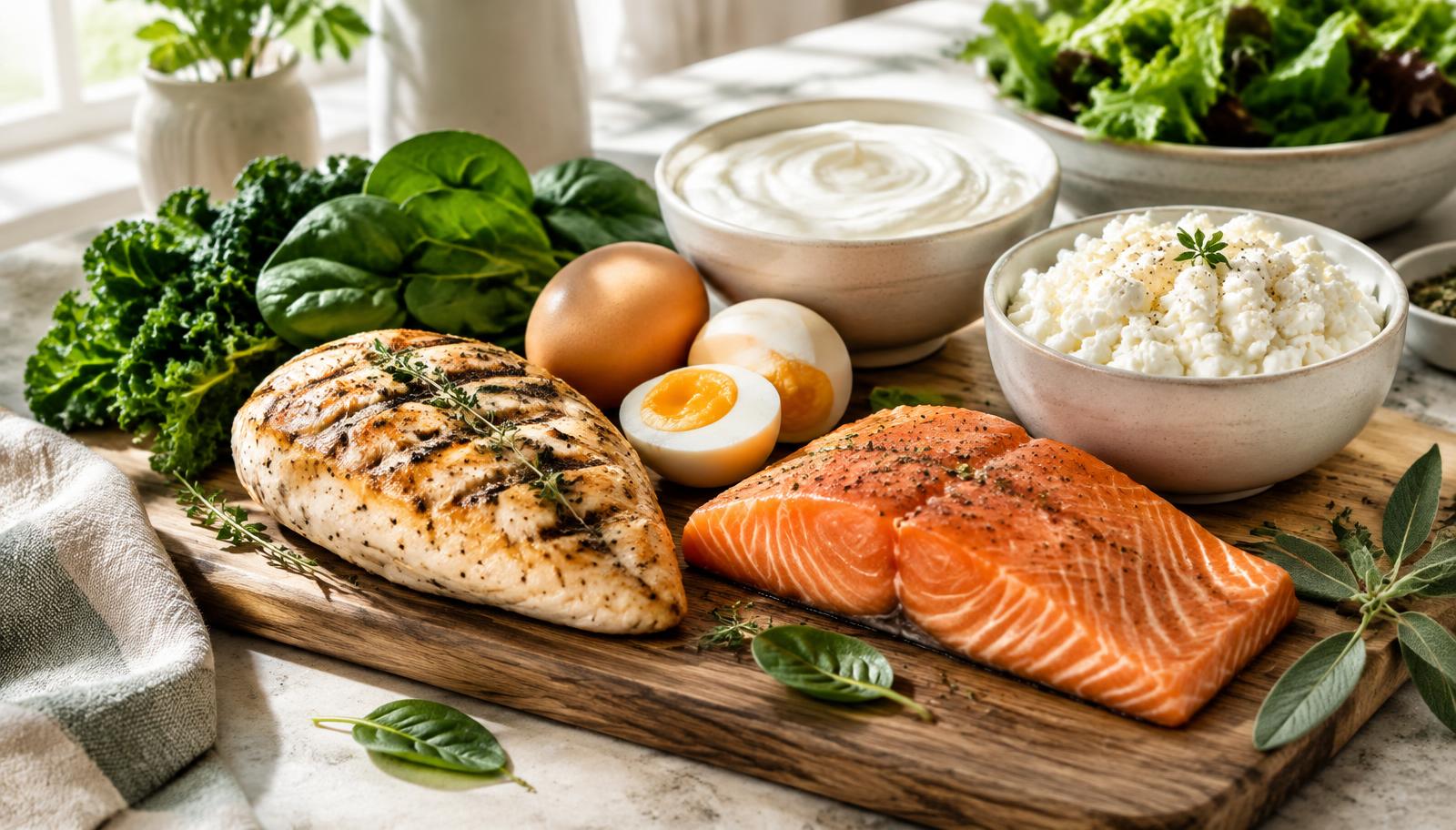
- Is there a clear protein source at each meal — eggs, poultry, fish, meat, Greek yogurt or cottage cheese?
- Is the protein portion the anchor of the plate, not a garnish?
- Do you feel reasonably satisfied for a few hours after eating?
- Is breakfast (if you eat it) more than coffee with cream?
- Are you ravenous in the evening? That can be a sign earlier meals were light.
Spreading Protein Across the Day
Many women find it easier to eat enough when protein is shared across meals rather than saved for one large dinner. The ESPEN group also highlighted spreading protein intake as a practical approach for older adults. You don't need exact timing rules — just a meaningful protein source each time you sit down to eat.
Protein Works Best With Movement
Protein supports muscle, but it does its best work alongside regular movement, especially some form of strength or resistance activity. Both expert groups above paired their protein guidance with exercise recommendations. Light weights, bands, or bodyweight moves at home all count.
When to Get Individual Guidance
Talk with your healthcare professional or a registered dietitian before significantly increasing protein if you have kidney disease or reduced kidney function, diabetes, liver disease, or any condition where protein intake has been discussed with you before. They can help you find an amount that fits your health, not a generic chart.
The Short Version
- There is no universal protein number for women over 40
- The adult RDA is a minimum baseline, not an ideal
- The 1.0–1.2 g/kg guidance comes from research on adults over 65
- Protein at each meal, plus regular movement, is a practical place to start
- Individual guidance matters if you have health conditions
For the foundations of why protein matters with age, see the shorter explainer, and for the full protein-first approach, head back to the main guide:
If you'd like simple meals already laid out, the free Keto After 40 Starter Kit includes a 7-day meal plan and grocery list.
This article is general education, not medical or nutrition advice. If you have kidney disease, diabetes, a heart condition, a history of disordered eating, take medication, or are pregnant or breastfeeding, talk with your healthcare professional or a registered dietitian before making significant changes to how you eat.
Sources
- Dietary Reference Intakes for Energy, Carbohydrate, Fiber, Fat, Fatty Acids, Cholesterol, Protein, and Amino Acids — National Academies (2005) →
- Evidence-Based Recommendations for Optimal Dietary Protein Intake in Older People — PROT-AGE Study Group, J Am Med Dir Assoc (2013) →
- Protein intake and exercise for optimal muscle function with aging: Recommendations from the ESPEN Expert Group — Deutz et al., Clinical Nutrition (2014) →
Want a simpler way to get started? Download the free Keto After 40 Starter Kit.
Get the Free Starter KitKeep going with Ketoach
Want ongoing keto support? Explore the Ketoach Community.
Explore Ketoach Community